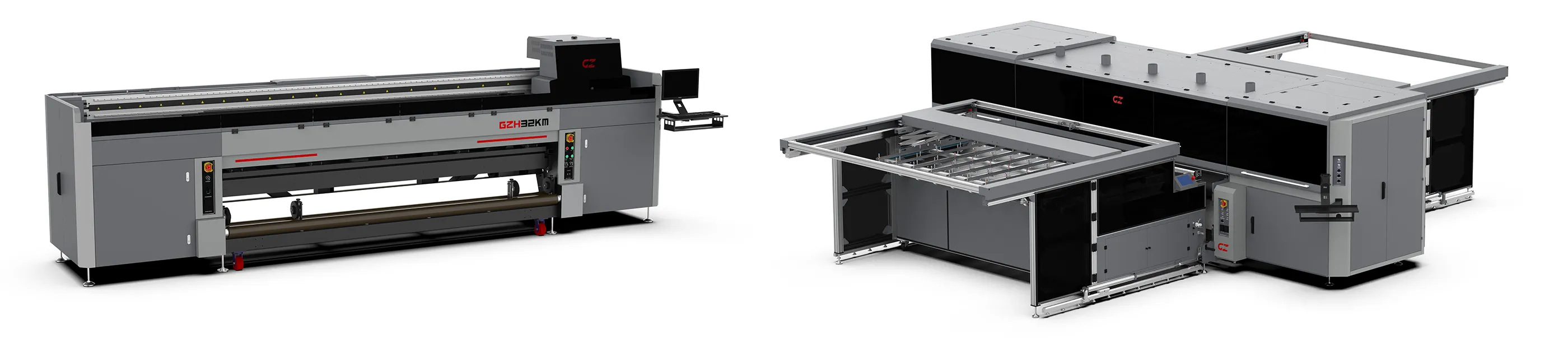
Q: What is the difference between Hybrid UV LED and Roll‑to‑Roll UV LED printers?
A: Hybrid and roll‑to‑roll printers differ mainly in how they transport print media. A hybrid UV LED printer uses a conveyor belt over a print plate, allowing it to handle both rigid boards and flexible roll materials. A roll‑to‑roll UV LED printer uses two sets of driven cylinders (usually rubber rollers) to create controlled tension across the print plate, keeping flexible materials perfectly flat and stable during printing.
Roll‑to‑roll printers offer superior control of roll materials, especially through torque‑based tensioning and synchronized speed control. This results in excellent stability, consistent print quality, and better long‑run performance for flexible substrates. Hybrid printers, on the other hand, are more versatile because they can print both roll materials and rigid sheets/boards.
Q: Which is better for my production — a Hybrid or a Roll‑to‑Roll UV LED printer?
A: The right choice depends on the materials you print most often and your production reality. If your production is primarily PVC banner, self‑adhesive PVC, canvas, backlit textiles (Samba, Dynajet, Barrisol), or sensitive films, a roll‑to‑roll printer such as the GZH52KM Pro or GZH32KM is the optimal solution. Roll‑to‑roll systems excel in repetitive, long‑run production where tension control and media stability are critical. If you also need to print rigid boards, then a roll‑to‑roll printer is not suitable, and a hybrid UV LED printer becomes the correct choice.
Q: I specialize in truck curtains. Can I use a Hybrid UV LED printer for this application?
A: Yes. A hybrid printer such as the GZF32KM Pro equipped with a heavy‑duty media handling kit can print truck curtains. However, dedicated roll‑to‑roll printers like the GZH52KM Pro or GZH32KM generally offer higher tolerance for material imperfections, better tension control, and more stable long‑run performance, making them the preferred choice for truck‑curtain production.
Q: My production relies heavily on PVC mesh and construction mesh. Can I use a Hybrid UV LED printer?
A: Hybrid printers can print mesh materials only if a liner film is applied behind the mesh. Without a liner, the open structure of the mesh cannot be supported on a conveyor belt. For unlined mesh, a roll‑to‑roll printer equipped with a mesh printing kit (standard on the GZH52KM Pro or GZH32KM) is the only professional and reliable solution.
Q: Can I print textiles with Hybrid and Roll‑to‑Roll UV LED printers?
A: Yes. Roll‑to‑roll printers handle most textiles very well, especially heavy fabrics such as canvas, industrial textiles, and functional textiles. Light or stretchy fabrics may require more careful handling due to tension. Hybrid printers apply less tension during transport, so they often handle lightweight or stretch‑sensitive fabrics better.
As a general rule, heavier textiles are better suited for roll‑to‑roll printers, while lighter textiles can be easier on hybrid systems. Gongzheng roll‑to‑roll printers also include a specialized print plate that improves handling of most textile types as long as the material is not excessively stretchy.
Q: I have a Durst Rho 312 or Durst Rho 512. What are the recommended replacement options?
A: For the Durst Rho 312 series, the closest functional replacement is the GZF32KM Pro, offering high reliability, excellent print quality, and strong productivity.
For the Durst Rho 512, the direct replacement is the GZH52KM Pro, which provides significantly higher output capacity and a much lower cost of ownership while maintaining industrial‑grade performance.
Q: I have an EFI VUTEk GS3250. Should I replace it with a Hybrid or a Roll‑to‑Roll UV LED printer?
A: A hybrid UV LED printer is the best replacement for the EFI VUTEk GS3250 because it supports both rigid boards and roll materials without major compromises. The GZF32KM Pro is the recommended successor, offering high versatility, strong roll‑to‑roll capability, and excellent performance in mixed‑media production environments.