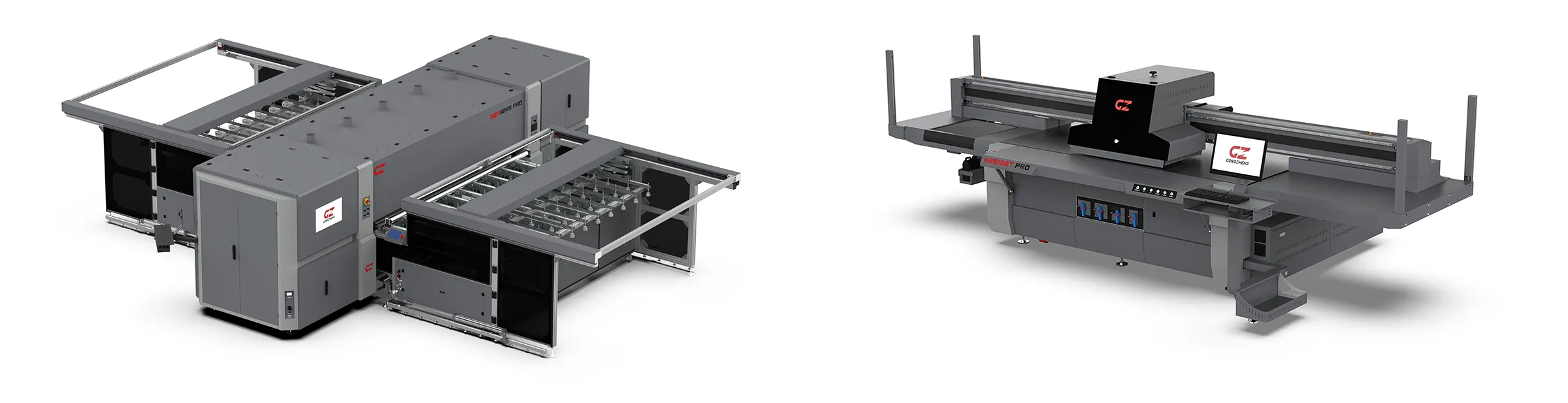
Q: What is the difference between Hybrid UV LED and Flatbed UV LED printers?
A: Hybrid and flatbed printers differ mainly in how they handle print media. A hybrid UV LED printer uses a conveyor belt to move the material while the printhead carriage travels along one axis (X‑axis). This design allows it to print both rigid boards and flexible roll materials, with print length limited only by the conveyor system.
A flatbed UV LED printer has a fixed print table, and the printhead carriage moves across both the X and Y axes. The print area is therefore limited by the table size (for example, 3.2 × 2 m). Flatbeds typically offer higher precision, easier operation, simpler maintenance, and lower space requirements, and they are often more cost‑efficient for rigid‑only workflows.
Q: I print both rigid boards and flexible roll materials. Which type of printer is the best choice?
A: A hybrid UV LED printer is the ideal choice when you need to handle both boards and roll media with minimal compromise. A model such as the GZF32KM Pro excels in mixed production environments where versatility and continuous roll‑to‑roll capability are important.
Q: My production is mostly rigid boards. Should I choose a flatbed or a hybrid UV LED printer?
A: For predominantly rigid‑board applications, a flatbed UV LED printer is usually the better option. A printer like the H3220KM Pro provides optimal material handling, stable registration, and efficient workflow for sheeted materials. Flatbeds are also easier to operate, require less space, and offer excellent print quality for rigid substrates.
Q: I want to automate my production. Should I choose a hybrid or a flatbed printer?
A: Automation depends on the type of materials you print. If you work with packaging cardboard, synthetic sheets, or flexible materials, a hybrid printer is easier to automate because of its conveyor‑based media transport. A system like the GZF32KM Pro supports automated feeding and stacking.
Flatbed printers can also be automated, but typically require robotic or cobot handling systems, and automation becomes practical mainly when operating multiple flatbeds such as H3220GN or H3220KM Pro in a production line.
Q: What is a good replacement for my Durst P10 HS printer? Should I choose a hybrid or a flatbed?
A: The best replacement depends on how you use your current Durst P10 HS. If you rely on its hybrid functionality, the GZF32KM Pro is the closest match in terms of versatility and production capability. If your P10 is used mainly for rigid boards, a flatbed such as the H3220GN or H3220KM Pro may be a better fit.
Q: I have a SwissQprint Nyala. What should I consider when expanding my production?
A: The SwissQprint Nyala is essentially a hybrid printer with a full‑size table, so your next step depends on your growth direction. If you want to expand rigid‑board capacity, a flatbed like the H3220KM Pro offers similar handling and workflow but with higher output.
If you want to replace your Nyala with a more modern hybrid system, the GZF32KM Pro (in a non‑automated configuration) is a strong option that maintains flexibility while increasing productivity.
