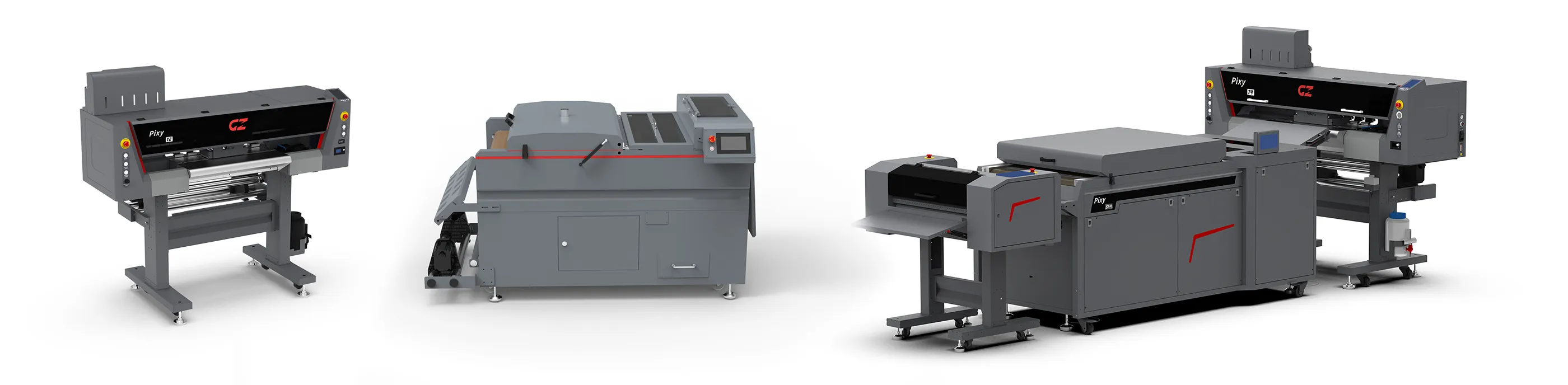
Q: What does DTF printing mean?
A: DTF stands for Direct‑to‑Film. It is a printing process where specialized water‑based pigment inks are printed onto a coated PET film. After printing, a fine adhesive powder is applied to the wet ink and then melted in a curing oven. The finished transfer film can be pressed onto almost any textile using a heat press, creating a durable print with excellent stretch and wash resistance.
Q: What is the advantage of DTF compared to traditional screen printing?
A: Screen printing requires screen preparation, color separation, stencil creation, and setup time, which makes short runs expensive and slow. DTF eliminates all preparation steps, so cost per print is predictable, even for very small batches or one‑off jobs. DTF also supports full‑color designs without additional setup, making it ideal for on‑demand production.
Q: What is the difference between DTF and DTG systems?
A: DTF prints onto film, while DTG prints directly onto the garment. DTG requires pretreatment, curing, and different settings for different garments (T‑shirts vs hoodies). DTF transfers are garment‑independent — the same print can be applied to cotton, polyester, blends, and many specialty fabrics.
DTG works best on cotton and is more industrial, but also significantly more expensive and more complex to operate. DTG also has significant problems achieving good results on cotton blends, poly-cotton, and polyester. DTF is simpler, more flexible, and easier to scale for small and medium production.
Q: What is the cost of ownership of DTF equipment compared to DTG?
A: DTF systems such as the Pixy T4 are far more efficient in terms of ink consumption, energy use, space requirements, and labor. There is no pretreatment, no curing step after printing, and maintenance is simpler. Overall, DTF cost of ownership is dramatically lower than DTG — often by an order of magnitude.
Q: If I purchase a Pixy T4, what additional equipment do I need?
A: The Pixy T4 is a complete DTF production line including printer, powder shaker, and curing oven. The only additional equipment needed is a heat transfer press to apply the finished transfers onto garments.
Q: What is the difference between DTF and UV DTF?
A: DTF uses water‑based pigment inks and a single transfer film. UV DTF uses UV‑curable inks and typically requires an A/B film system. UV DTF systems (such as the Gongzheng Pixy U3) require less space, consume less energy, and are ideal for transferring graphics onto rigid and 3D objects like bottles, cases, and promotional items.
DTF is optimized for textiles, while UV DTF is optimized for hard surfaces.